giazitanews.com
The post Exploring Asia’s Realm of Flying Snakes appeared first on A-Z Animals.
Quick Take
The flying snakes of Asia are truly remarkable creatures with a unique ability to maneuver between treetops.
These snakes do not fly like winged creatures, instead launching themselves through the air to reach a new location.
The 5 species of flying snakes are the golden tree snake, the Moluccan flying snake, the paradise tree snake, the Sri Lankan flying snake, and the banded flying snake.
The idea of a “flying snake” sounds like something out of mythology or science fiction. But in the forests of South and Southeast Asia, these remarkable reptiles are very real. Belonging to the genus Chrysopelea, flying snakes don’t truly fly in the way birds or bats do. Afterall, they lack wings. Instead, flying snakes glide through the air with astonishing control, launching themselves from trees and maneuvering between branches with a movement that looks almost impossible.
Their unusual relocating ability is only part of what makes them so fascinating. Flying snakes are also beautifully patterned and highly adapted to life in the treetops. Compared to other snake species, these arboreal reptiles are not widely understood. Based on what biologists have studies, these snakes are a striking example of how evolution can produce remarkable creatures.
What Do Flying Snakes Look Like?

©Vince Adam/Shutterstock.com
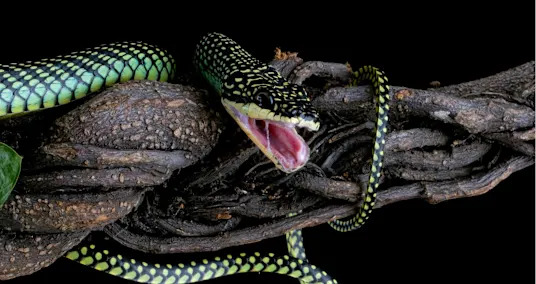
Although each species of flying snake has its own unique appearance, most flying snakes are green or a greenish-yellow color. Some species have additional colors and patterns, ranging from dark grey and black to bright red, yellow, and orange. These colors often form crossbars and tiny speckles, or they can be shaped like flowers or flower petals running along the middle of the snake’s back. Flying snakes are much more slender than other snake species, which helps them with their gliding abilities.
Why Do Snakes Fly?

©Vince Adam/Shutterstock.com
Gliding likely helps flying snakes move efficiently between trees while reducing the need to descend to the forest floor. In this way, flying snakes can avoid many of the predators that live on the ground.
How Do Snakes Fly?

©Vince Adam/Shutterstock.com
Despite their name, “flying snakes” do not actually fly, at least not in a traditional manner. Instead, these snakes launch themselves from branches and glide through the air to their destination. The backs of these snakes are smooth and glossy, but the scales on their bellies are ridged. Flying snakes climb vertically up trees by pressing and moving these texturized belly scales against the tree bark.
When a flying snake wants to relocate, it will move out onto an extended branch and dangle its body down, holding onto the tree with only the end of its tail. As the snake hangs from the tree, it will form its body into a “J”-type shape and lean forward. The snake then throws its entire body out and away from the tree, catapulting into the air.
As it soars through the air, the snake sucks in its stomach, flattening its body into a concave, wing-like shape by spreading its ribs. Like a flying disc or frisbee, this concave, flattened shape creates air pressure under the snake’s body and propels it along, allowing the snake to fly or glide across long distances.
While in the air, flying snakes also twist their bodies back and forth in an undulating motion. This helps the snake to stabilize its direction while still in the air and control its landing. As strange as it may look, this undulating motion actually increases the snake’s gliding ability and aerodynamics, making it look as if it were effortlessly swimming through the sky. Some flying snakes have been observed gliding remarkable horizontal distances, but exact range and speed vary by species, launch height, and conditions.
Where Do Flying Snakes Live?

©PeterHermesFurian/iStock via Getty Images
Chrysopelea, more commonly known as the flying snake or gliding snake, is a genus that belongs to the family Colubridae. These arboreal snakes are found across South and Southeast Asia, including India, Sri Lanka, southern China, and parts of the Indonesian archipelago.
They inhabit trees, living among the branches and leaves, where they hunt for lizards, frogs, and other small animals as their prey. The flying snake is an excellent climber due to its strong prehensile tails, which can be used to grip tree trunks or branches. They spread their ribs outward to flatten the body into a gliding airfoil-like shape. This body shape helps them glide efficiently between trees.
What Is the Largest Flying Snake in the World?

©JoeFotoSS/Shutterstock.com
The largest flying snake is often cited as either the Moluccan flying snake (Chrysopelea rhodopleuron) or the golden tree snake (Chrysopelea ornata), depending on the source and measurement. Both can reach roughly 4 feet (about 120 cm).
The Moluccan flying snake lives on Indonesia’s Sulawesi and Ambon islands. Unfortunately, we do not know a lot about it yet.
The golden tree snake (or ornate flying snake) has a thicker body than the other species of flying snakes, weakening its gliding ability. A golden tree snake certainly can still glide from tree to tree, but not nearly as well as many of the other smaller flying snakes.
There are two main color patterns of the golden tree snake. The first, primarily found in southern India and Sri Lanka, has a pale green or a greenish-yellow colored body. Each of its green scales have a small black mark, and many have black outlines around the scale. The snake’s head is black with solid and broken yellow crossbars.
Snakes in Sri Lanka sometimes have orange or reddish blotches along the middle of their backs as well, shaped like flowers. Golden tree snakes in Southeast Asia, on the other hand, do not have these spots. These snakes are often more of a bright green color with duller crossband patterns.
The golden tree snake occurs across parts of South and Southeast Asia, including India, Sri Lanka, and parts of mainland and island Southeast Asia. Golden tree snakes often live in secondary or re-grown forests, although many have adapted quite well to more developed areas like rural gardens and plantations.
In some parts of their range, golden tree snakes may enter human structures such as roofs or garden buildings while hunting prey. They can scale vertical walls with ease and commonly hunt mice and geckos in and around the structures. Golden tree snakes commonly prey on lizards and other small vertebrates, and in some areas may take geckos, frogs, birds, bats, or rodents.
How Big Are Other Flying Snakes?

©PACO COMO/Shutterstock.com
There are five different species of flying snakes:
Golden tree snake
Moluccan flying snake
Paradise tree snake
Sri Lankan flying snake
Banded flying snake
Paradise Tree Snake

©Vince Adam/Shutterstock.com
The paradise tree snake grows up to 3 feet in length. These snakes are popular in the European pet trade. The paradise tree snake is one of the best-known and best-studied flying snakes, though sightings still depend heavily on habitat and region. They can be found in Singapore, Thailand, Indonesia, and Cambodia. This snake is often green and black, sometimes with red, orange, or yellow markings depending on locality and pattern variation. The paradise tree snake is the best glider of all five flying tree snake species.
Banded or Twin-barred Flying Snake

©Stephane Bidouze/Shutterstock.com
The banded flying snake (Chrysopelea pelias) is generally regarded as the smallest species in the group. This small snake only grows up to 2 feet in length, half the size of the largest flying snake in the world. The banded flying snake has a reddish or dark gray body, with white or yellow, black, and red, stripes.
The sides of the snake’s body are light brown or grey with white spots, and its belly is white and yellow. Although the colors and patterns of the banded flying snake are easy to recognize, it is less commonly encountered than some of the other flying snakes. It lives in the humid forests of Singapore, Malaysia, and Indonesia.
Flying Snakes as Pets

©Kurit afshen/Shutterstock.com
Because of their unique abilities and bright colors, flying snakes are becoming more popular for reptile collectors. Flying snakes are mildly venomous rear-fanged colubrids, but they are generally not considered dangerous to humans. However, these snakes can be stress-prone in captivity and may bite defensively when handled. Flying snakes are generally considered challenging to keep and breed in captivity due to their anxious nature. In addition, snakes caught in the wild often bring along many parasites when transferred to captivity.
Flying Snake Robots

©frantic00/Shutterstock.com
Researchers often look to nature for inspiration when designing new forms of robotics. A great example is the design of Snake Robots, which are patterned after the anatomy and movements of various snake species, including the flying snake. Snake robots are particularly useful in disaster relief and rescue missions.
Researchers have explored snake-like robots for search-and-rescue, inspection, and potentially future medical applications. Many scientists are continually studying flying snakes’ anatomy and gliding techniques with the hope that this knowledge can further advance these serpentine robots and their abilities.
The post Exploring Asia’s Realm of Flying Snakes appeared first on A-Z Animals.
Latest Articles
- 1
 Jesse Jackson hospitalized, under observation for a neurodegenerative condition
 - 2Second doctor in Matthew Perry overdose case sentenced to home confinement
- 3You finally got a doctor's appointment. Here's how to get the most out of it
- 4Regeneron's experimental therapy combo effective in untreated cancer patients
- 5Scientists train to dive beneath polar ice as climate change warms the Arctic and Antarctica



Related Articles